
Bristol is the most settled racetrack in the Cup Series. 15 different drivers have won the 40 races there since 2005, the fewest winners per race of the 31 tracks on the circuit, and over the last 5 Bristol races a group of 6 has separated from everybody else. Ryan Blaney averages a 6.6 finish across those 5. Ty Gibbs is at 7.6, Chase Briscoe 7.8, Kyle Larson 8.4, Denny Hamlin 9.4 and Christopher Bell 10.2. The same gap shows up in the projections for Saturday. Those 6 project to finish between 5th and 7th, and the next 2 names below them, Tyler Reddick and Joey Logano, both project to finish 10th.
That kind of consistency is strange at a 500-lap race where the leaders hit lap traffic almost immediately and there is contact in every corner, and the books have noticed. As of Thursday morning, 5 of those 6 were the 5 shortest prices on DraftKings Sportsbook, and Briscoe was the one left out. So the question this week is not who is good at Bristol. It is what you have to pay for them, and where the price is wrong.
The six, and what they cost
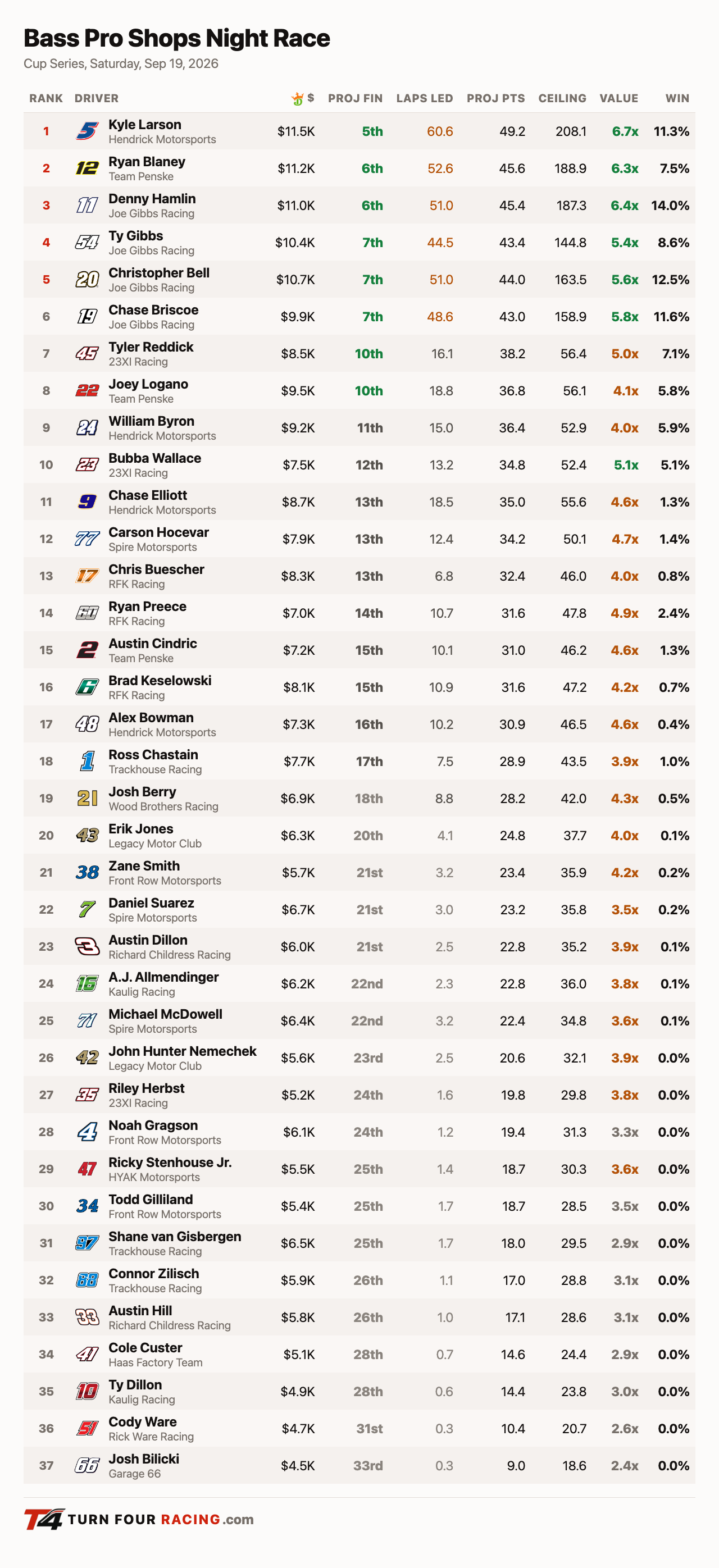
We run the race 10,000 times before the green flag, and every number on the table comes out of those runs.
Projects to finish 7th is a driver's median finish across the 10,000 runs: he finishes 7th or better in half of them and 7th or worse in the other half.
Win 18.8% is the share of runs he won. Top 10 84% is the share of runs he finished inside the top 10.
The table is ordered by average finish, which is why 2 drivers who project to the same finish can sit in different rows.
Larson projects to finish 5th. Blaney and Hamlin project to finish 6th, and Gibbs, Bell and Briscoe all project to finish 7th. As of Thursday morning DraftKings Sportsbook had Larson +400, Hamlin +500, Blaney +550, Gibbs +600 and Bell +700. Larson's win chance is 11.3%. Then comes the gap the whole piece is about: Briscoe is +1100, the same price as William Byron, and his DraftKings salary is $9,900 against $10,400 for Gibbs and $10,700 for Bell.
The record says he belongs with the other 5. Briscoe finished 5th at Bristol this April, 9th in last September's Night Race, 4th in the spring 2025 race and 8th in the fall 2024 race, when he was still at Stewart-Haas. He and Blaney are the only 2 drivers entered Saturday with a top-10 in each of the last 4 Bristol races. His 11.6 average finish at Bristol is 3rd of the 35 drivers entered with 3 or more starts there, behind Gibbs at 11.1 and Larson at 11.2, and it is not a Bristol fluke. Across Bristol's kind of track, the steep-banked ovals, Darlington, Dover, Homestead and Las Vegas among them, he averages 8.3 over 12 starts against 14.9 everywhere else, the biggest gap of anyone in the field.
The sim agrees with the record. Briscoe's 11.6% win chance is within a point of Bell's 12.5% and better than Gibbs at 8.6% and Blaney at 7.5%, both of whom cost more. He finishes top-10 in 62% of our runs and projects for 48.6 laps led, and the crowd is not there: 24.5% projected ownership, the lowest of the 6 by a distance. Blaney is at 37.6%, Gibbs 38.1%, and Larson at 48.9% is the highest number in the field.
What the market is pricing is the last month. Briscoe came home 6th at Darlington 2 weeks ago and led laps, then got collected in somebody else's wreck at Gateway. Before that came a 13th at Daytona and a 26th at New Hampshire in a race the rain turned upside down, and before that he was on a run: the Chicagoland win, 2nd at Sonoma and 3 more top-5s at North Wilkesboro, Indianapolis and Richmond. The books have been slow on him all year. Across the 23 races this season where we captured a price on him, they have had him the 9th shortest price on average and he has finished 11.8. A driver priced 9th usually finishes 3.4 spots worse than that, and only Hamlin, Austin Cindric and Daniel Suarez beat their price by more among the 36 drivers entered. The books price the month. The record prices the track.
The favorite, and the disaster
Larson runs closer to the front at Bristol than anyone with history there. His average running position across 20 starts is 9.8, and nobody in this field runs that well away from Bristol: across every other Cup track, the best average running position anyone entered carries is Hamlin's 12.2, and Larson's own is 12.6. He led 462 laps to win the fall 2024 race and 411 to win the spring 2025 race. Then last September's Night Race was a disaster. He started 5th, led 0 laps and finished 32nd. This April he was back out front with 284 laps led, and finished 3rd behind a winner who led 25.
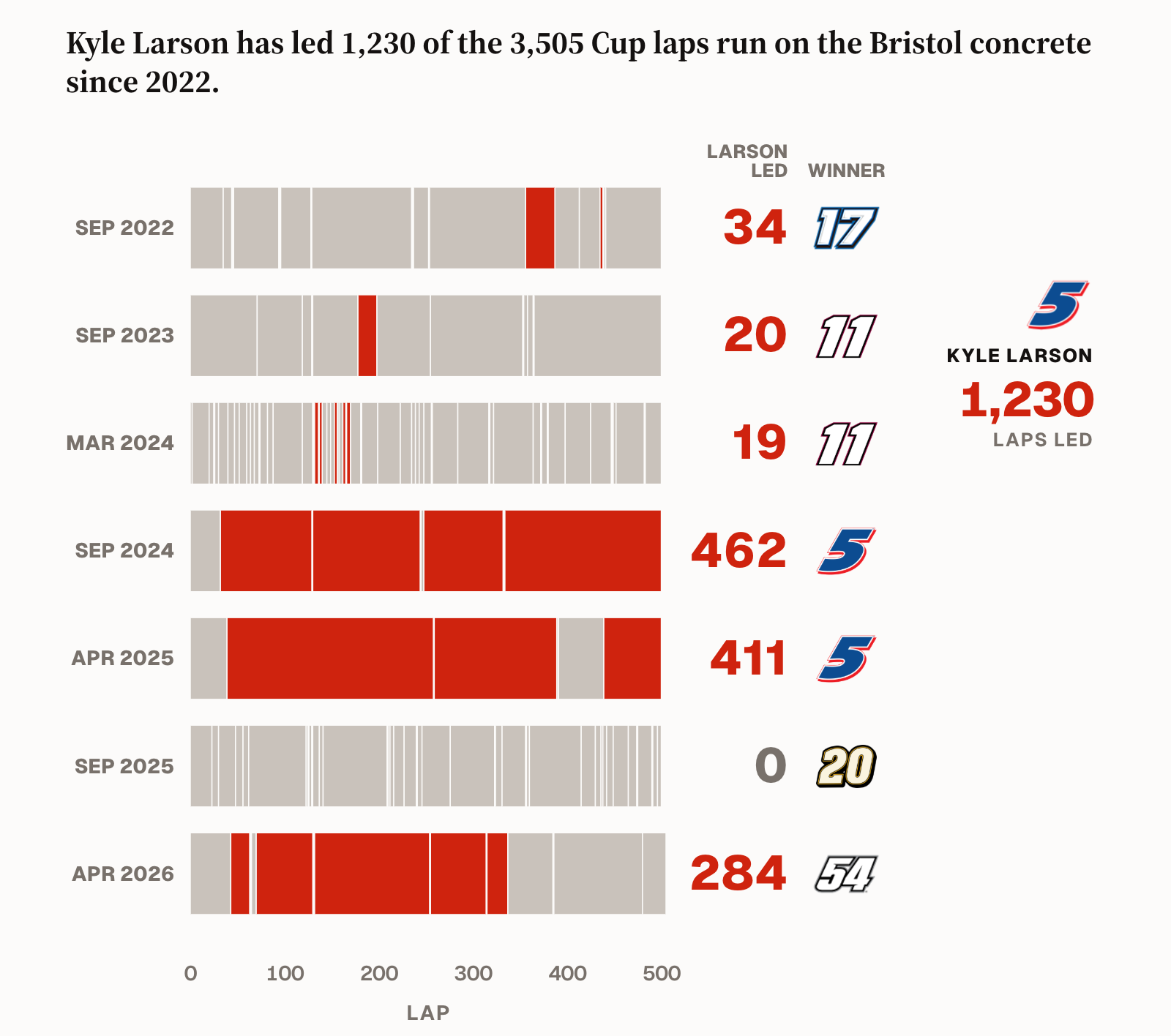
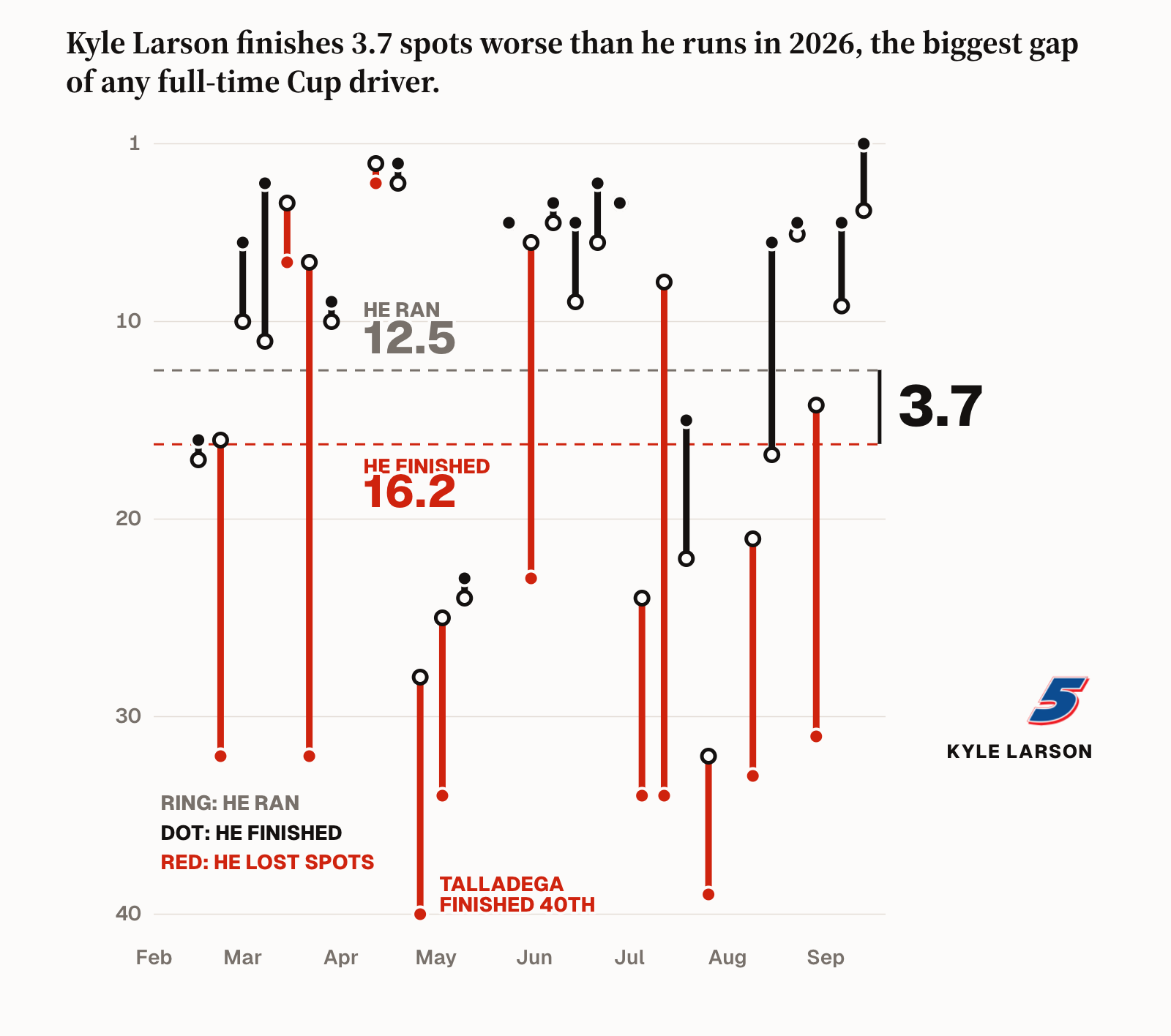
That is the whole Larson season in one track. He has finished at least 10 spots worse than he ran in 8 of his 28 races this year, and 9 of those 28 finishes are 30th or worse. Gateway went the other way, a 4.4 average running position and the win, which is why he is the favorite and why he projects for 60.6 laps led, the most in the field. He also carries the heaviest ownership in the field at 48.9%, and across the 72 DraftKings tournaments we have captured this season, nobody in this field gets played harder than he scores: the crowd ranks him 8.1 places higher than his points do, the widest gap of the 37 drivers entered.
For a cash game that is fine. He finishes top-10 in 71% of our runs. For a tournament it is the chalk problem in its purest form: half the field has the No. 5 at $11,500, and 9 of his 28 races this season ended 30th or worse. If he leads 400 laps you cannot win without him. If Saturday is the other kind of Larson night, the lineups without him are the only ones left standing, and there are not many of them.
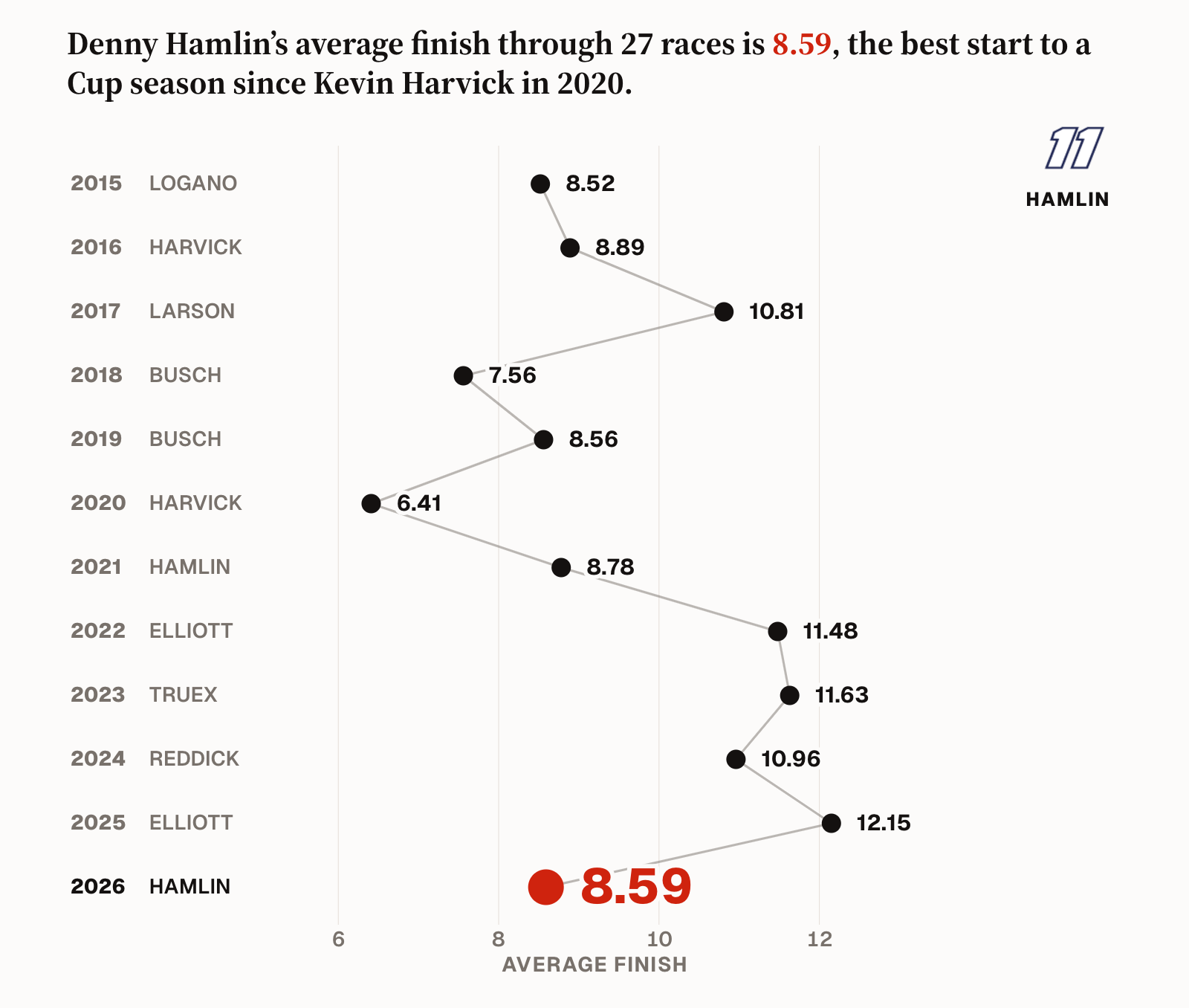
The steadier version of the favorite is Hamlin. He wins 14.0% of our 10,000 runs, the best win chance in the field, and finishes top-10 in 80% of them, also the best. His average finish this season is 8.6 through 28 races, more than 3 spots clear of anyone else entered; it was 8.59 through 27 when we posted the card below a week ago, and his 9th at Gateway barely moved it. He also beats his price by more than anyone. Across the 24 races this season where we had a market on him, the books have had him the 4th or 5th shortest price on average and he has finished 7.6, which is 6.1 spots better than drivers priced there usually finish, the biggest gap of the 36 drivers entered. His 4 Bristol wins are the most of anyone entered, and he leads the Chase on 2,168 points, 9 clear of Larson and 18 clear of Bell. The 2 men at the top of the standings finished 31st and 32nd in last year's Night Race.
The laps and the trophy come apart
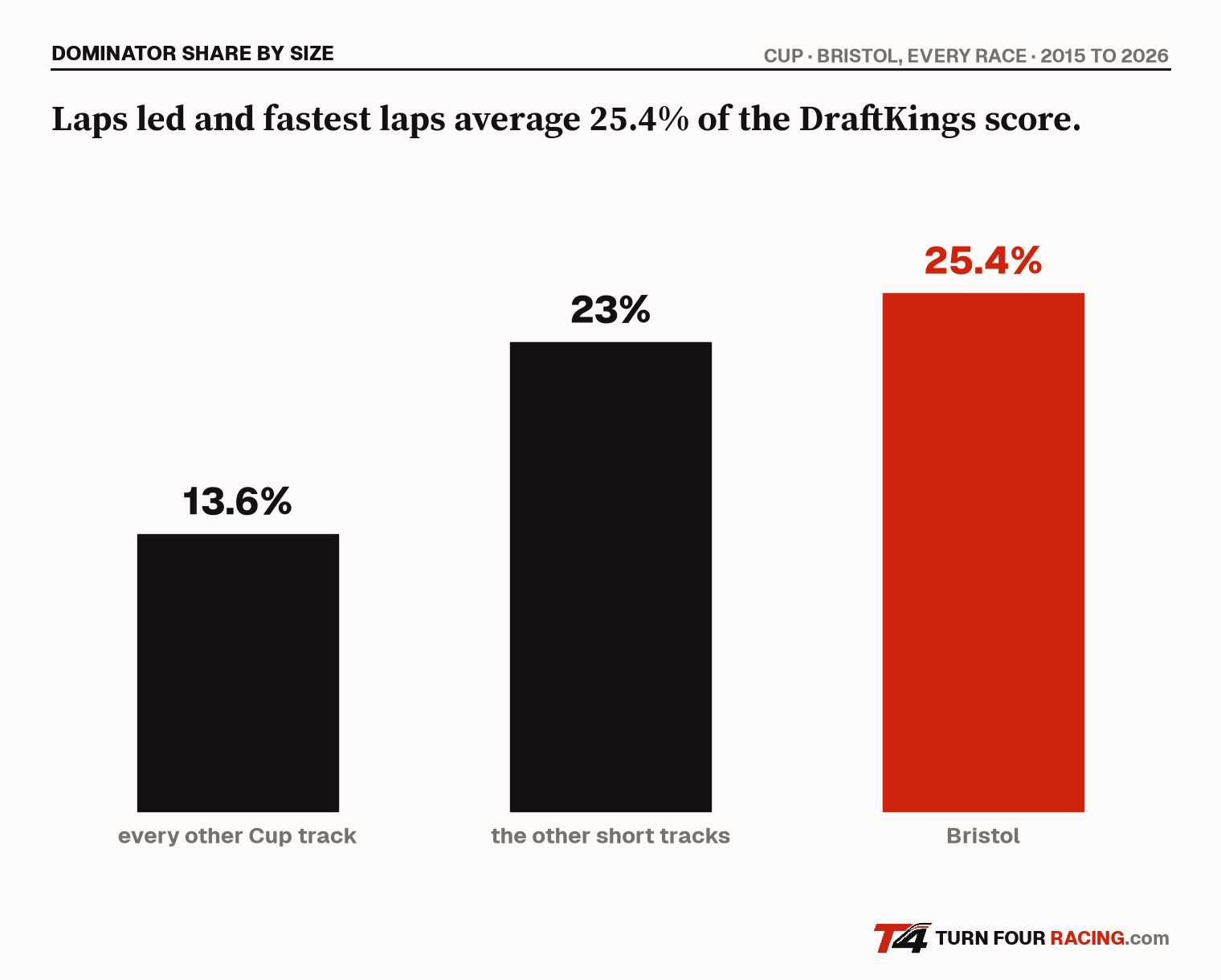
Bristol pays for domination the way the short tracks do, and a little more. Laps led and fastest laps carry 25.4% of the DraftKings scoring in an average Bristol race, measured across the last 20 of them, the highest share of the 31 tracks, with Martinsville right behind at 24.7% and the other short tracks averaging 23.0%. Every other Cup track averages 13.6%. On a normal weekend that means you find the dominator and build around him. At Bristol the dominator and the winner have stopped being the same car.
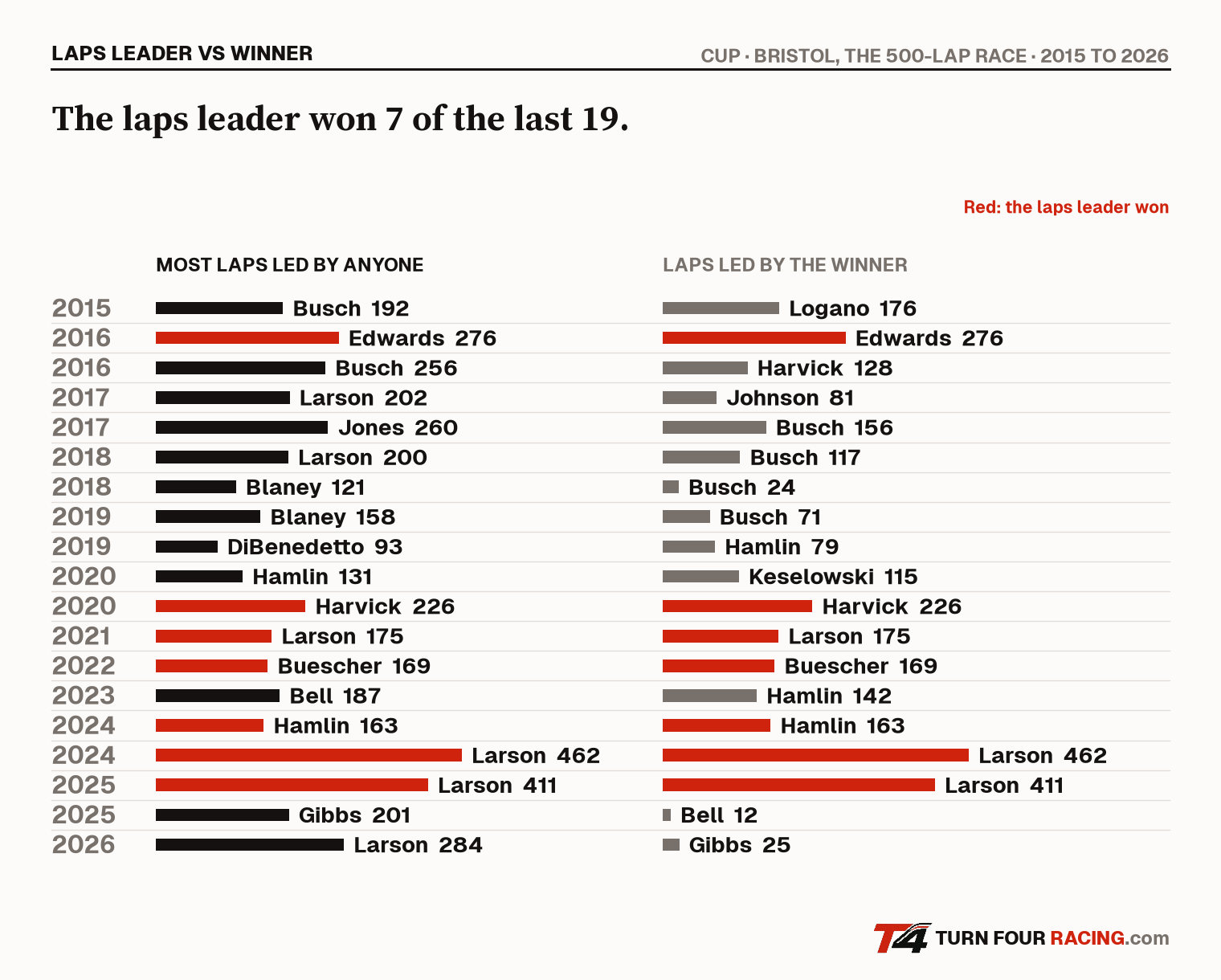
The last 2 Bristol winners led 37 laps between them. Bell won last September's Night Race from 9th after leading 12, on a night Gibbs led 201 and finished 10th. Gibbs won this April leading 25 while Larson led 284. Bristol has run 20 Cup races since 2015, and the driver who led the most laps won 7 of them and lost 13. At Bristol the driver who scores the laps-led points and the driver who wins are often 2 different cars, and a lineup can carry both.
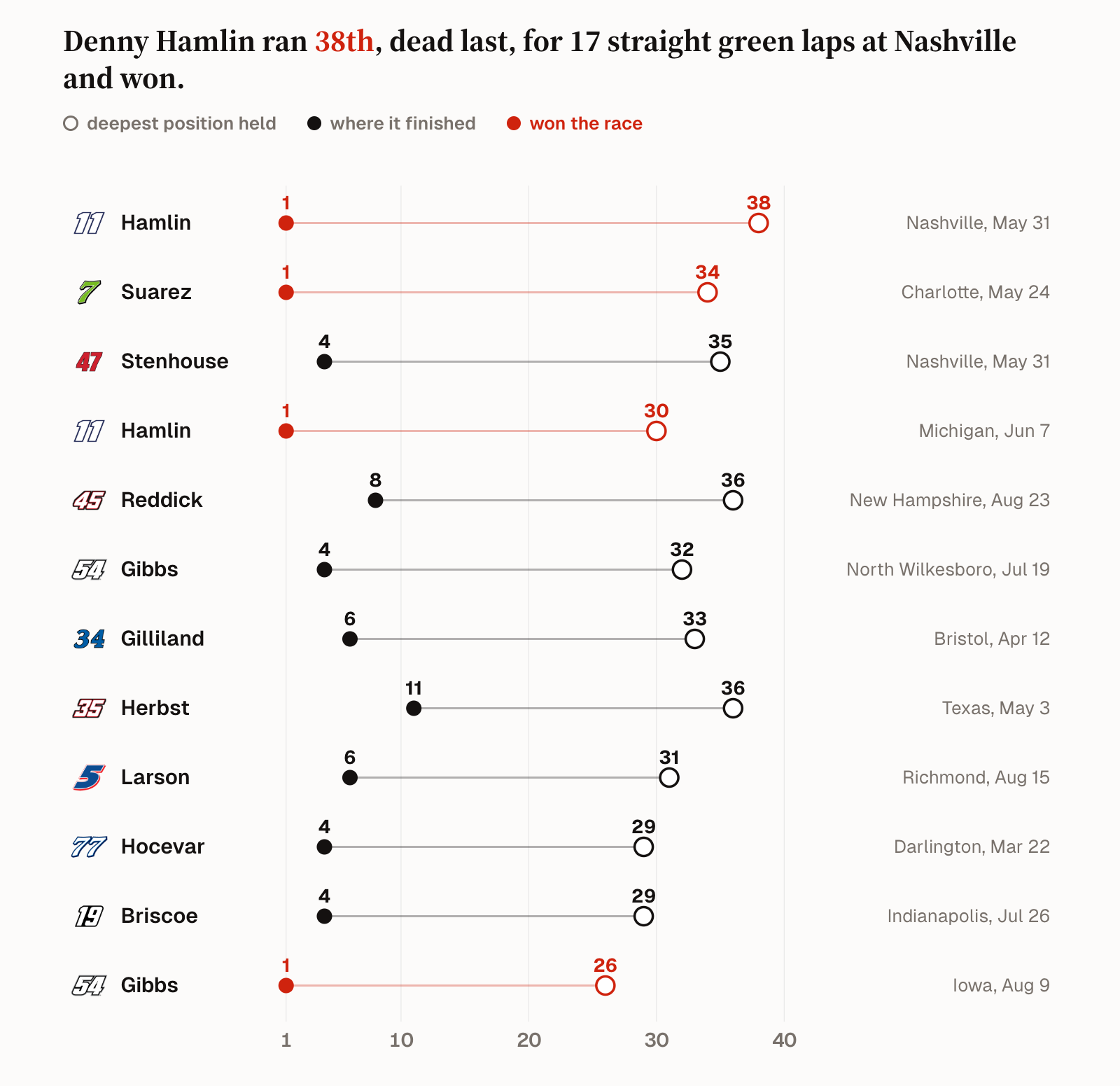
Blaney is that chart in one career. He has led 775 laps at Bristol across 19 starts, the 5th most of anyone entered, and every driver above him on that list has won there. He has not. He qualifies 8.2 on average at Bristol and finishes 16.3, 8.1 spots lost between the green and the checkered. The sim reads him the same way: 52.6 projected laps led, 2nd most in the field, and a 7.5% win chance, the lowest of the 6. Gibbs is the reminder that the trophy can go to the other car. He has led 363 laps over the last 5 Bristol races, and the April win came on 25 of them.
The projections page re-runs 10,000 sims every time driver news hits the wire or a session wraps up, for all 3 Bristol races.
See the numbers as they moveWhere the movers are
Start-to-finish is the wrong way to find them, because a driver who qualifies 3rd has nowhere to go and one wreck poisons his average. The better number is the green-flag pass differential, passes made minus times passed, and over the last 5 Bristol races it belongs to Brad Keselowski: plus 70 net passes, the best of the 34 drivers entered with history there, ahead of Gibbs at 58, Blaney at 51 and Ryan Preece at 50. Keselowski qualifies 16th at Bristol on average and finishes 12th. The sim has him projecting to finish 15th at $8,100. His projected ownership is 16.0%, and DraftKings had him +2800 on Thursday morning. That is the place-differential play, and it is a top-10 ticket priced off where he qualifies rather than where he ends up.
Preece is the cheaper version at $7,000, projecting to finish 14th from a 20th average start. And the number runs the other way just as hard. Bubba Wallace is minus 58 over the same 5 races, the worst of the 34, qualifying 12th and finishing 20th, and the sim still projects him to finish 12th. He carries 20.9% projected ownership anyway. Josh Berry loses more ground green to checkered than anyone entered with 3 or more Bristol starts. Those 2 are the fades no matter where they roll off Friday.
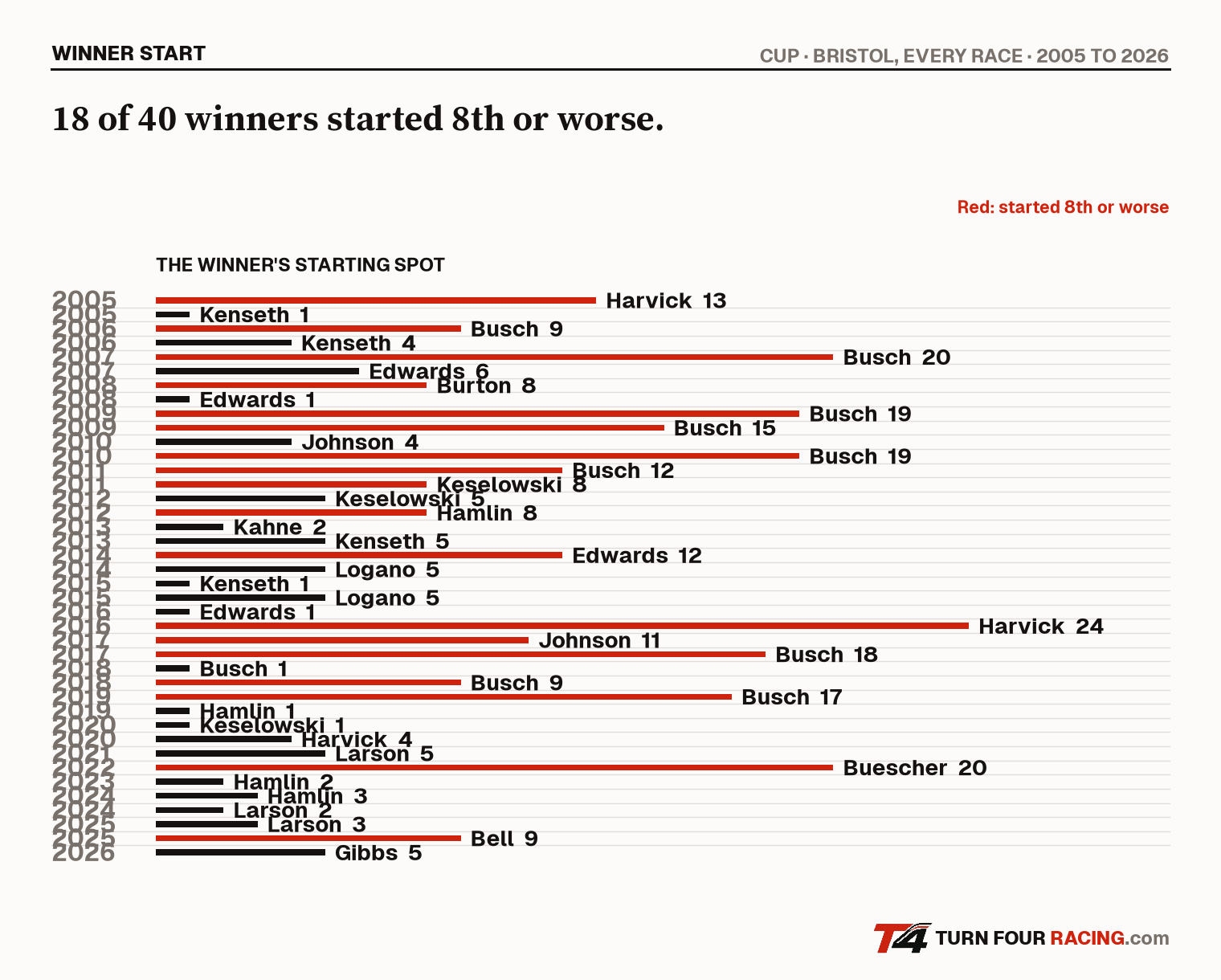
Which brings up Friday. The 40 Bristol winners since 2005 started 8.0 on average, 18 of them started 8th or worse, and the deepest came from 24th. A good lap helps and a bad lap is survivable, which is exactly the condition a mover needs.
Friday night: the Food City 300
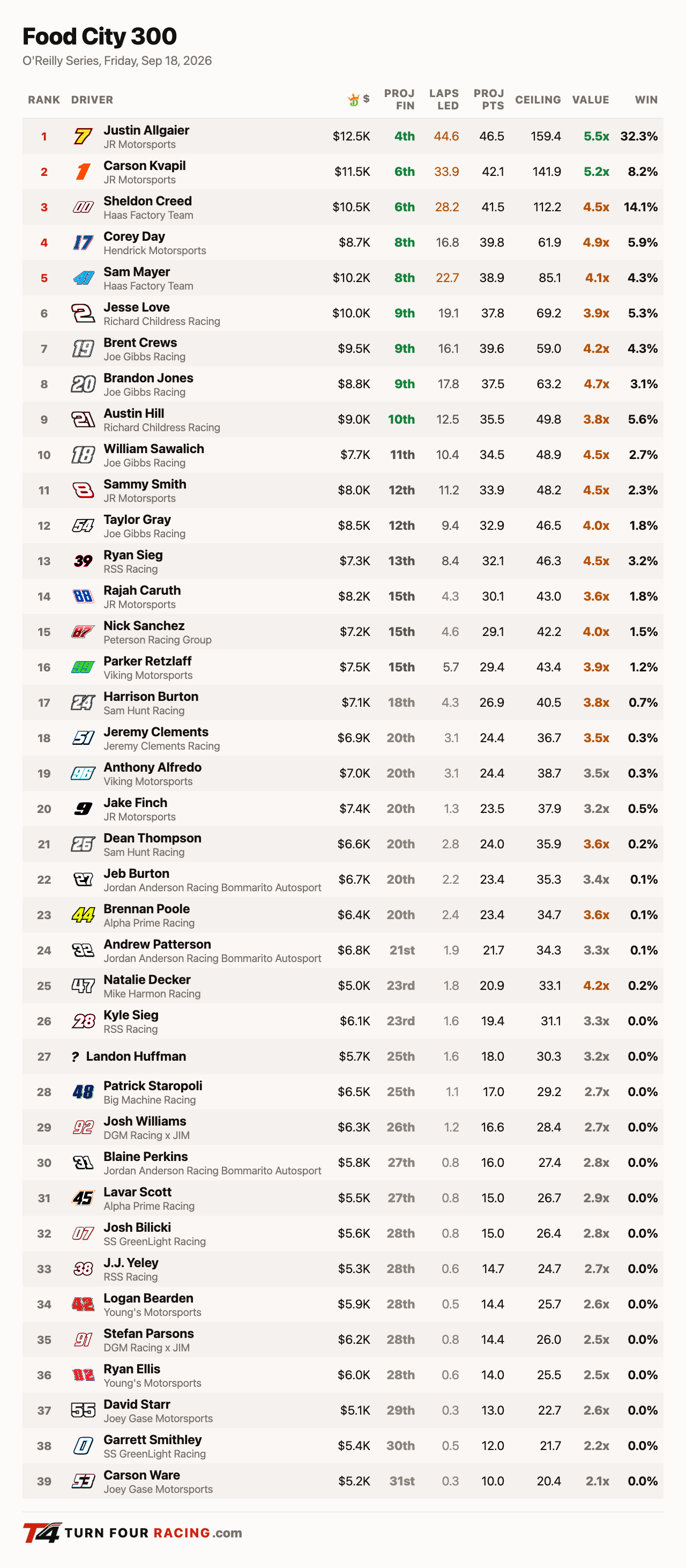
Justin Allgaier is the biggest favorite on either table this weekend. He projects to finish 4th. His win chance is 32.3% and he finishes top-10 in 89% of our runs, and he costs $12,500 with 48.5% projected ownership, so the whole field will have him and he will probably earn it. The value sits underneath. Sheldon Creed carries the 2nd best win chance in the race at 14.1%. He projects to finish 6th at $10,500, and Carson Kvapil projects to finish 6th as well. Kvapil's top-10 rate is 83%. Corey Day projects to finish 8th at $8,700, the cheapest of the top 5 on the table.
The Food City 300 goes green Friday, Sep 18 at 7:30 pm ET on The CW. O'Reilly Series practice runs Friday, Sep 18 at 2:00 pm ET, with qualifying right after it.
Saturday night
The Bass Pro Shops Night Race goes green Saturday, Sep 19 at 7:30 pm ET on USA Network. Cup practice runs Friday, Sep 18 at 4:30 pm ET, with qualifying right after it. This is race 3 of the 10 that decide the Chase, and there is nothing to advance to and nobody to eliminate, so every point is a point on the table in November. Practice and qualifying will move these numbers, and the projections page re-runs all 10,000 sims when they do. We would not be shocked if the top 3 on Saturday night is 3 of the 6 names at the top of this page. The one we keep coming back to is the one that costs the least.
Thursday night: the UNOH 250
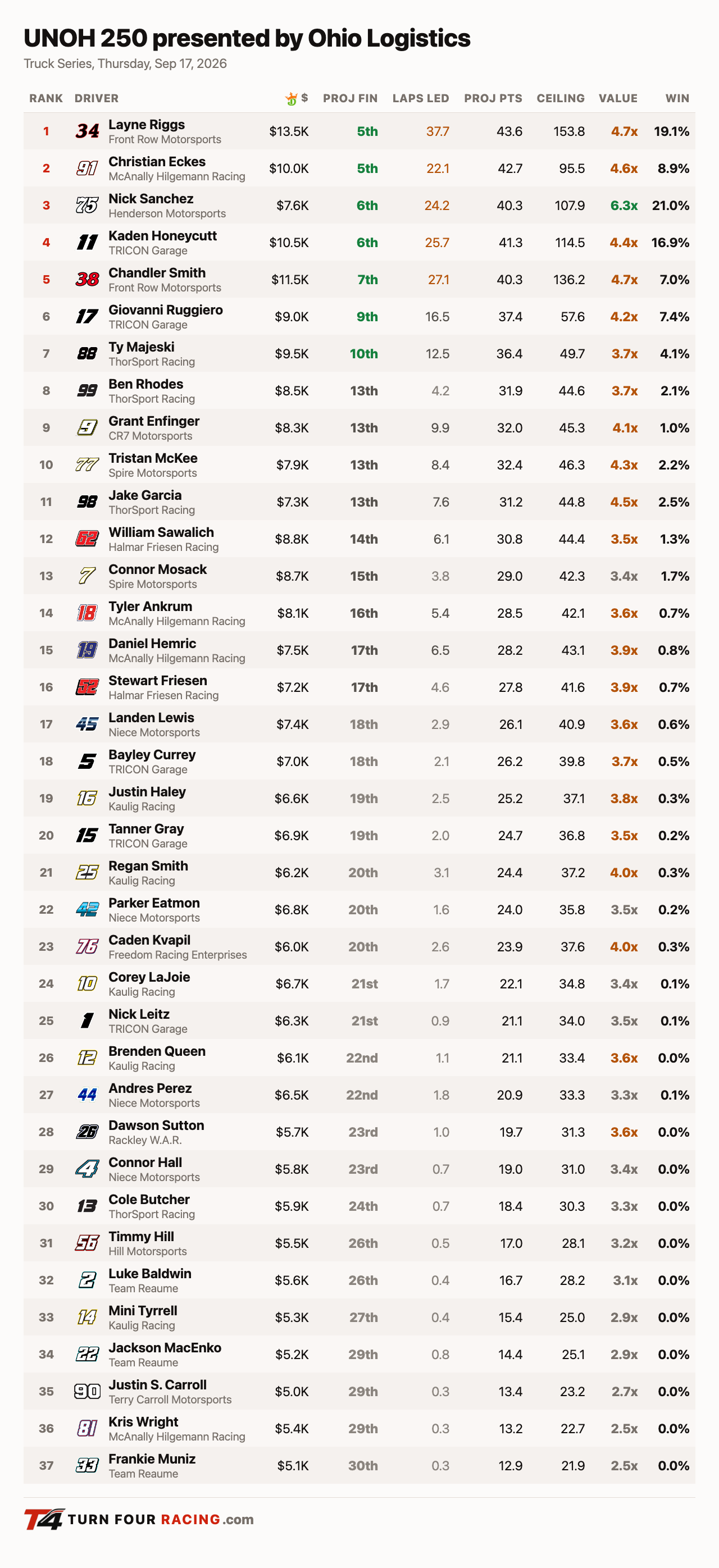
The UNOH 250 presented by Ohio Logistics goes green Thursday, Sep 17 at 8:00 pm ET on FS1. Truck Series practice runs Thursday, Sep 17 at 3:00 pm ET, with qualifying right after it.
Full projections for all 3 Bristol races, re-simmed through qualifying and driver news, right up to the green flag. The dynamic projections page is $5 a month; Pro opens the whole site.
See the full Bristol projections Plans, from $5 a monthNew here? We send one email a week: full projections for every race on the schedule. Free, every Thursday.
Get the Thursday email