
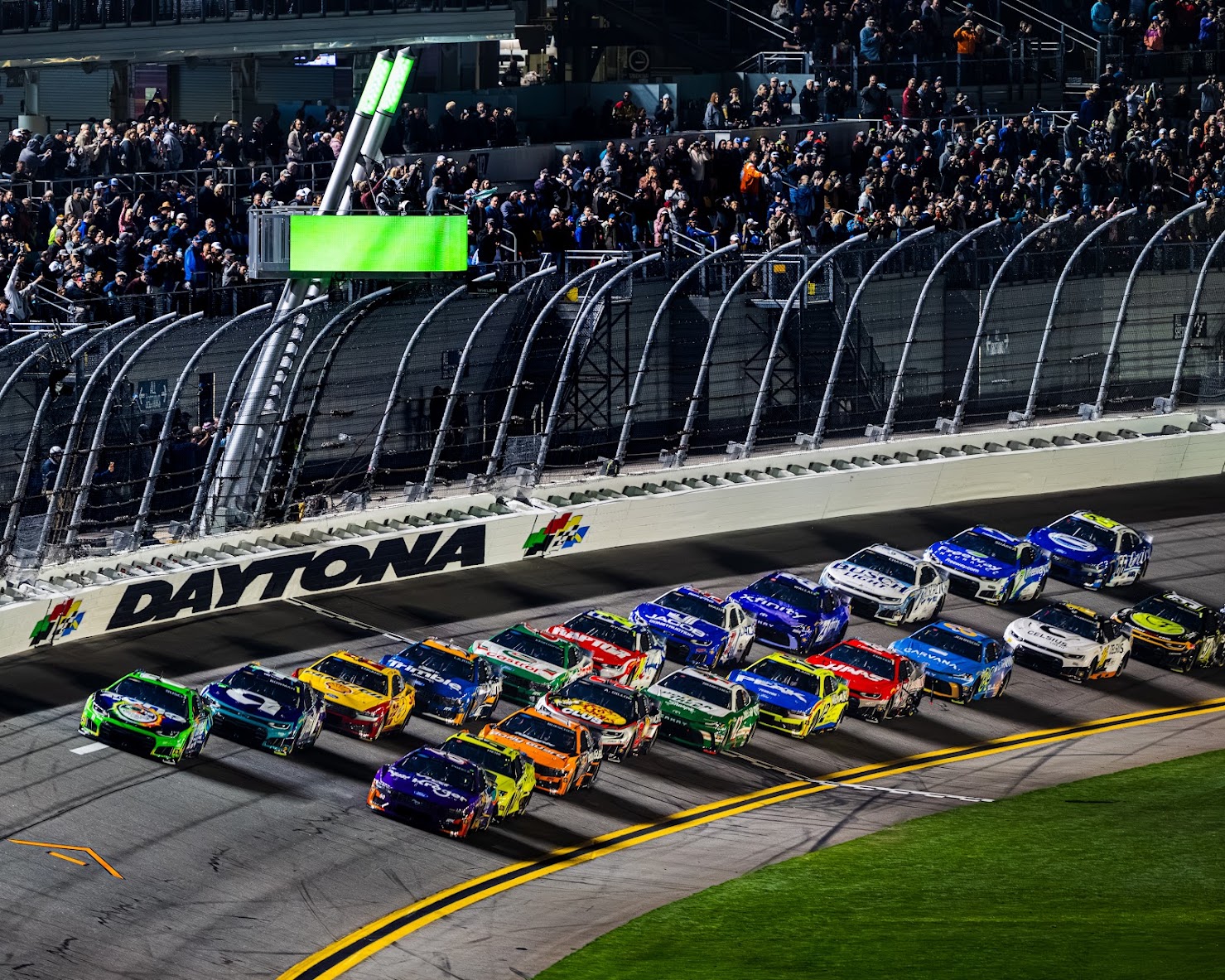
Photo by Patrick J. Valley, pjvphotography.com
The Cup regular season ends Saturday night at Daytona, 7:30 ET on NBC. Whoever sits in the top 16 in points when the checkered flag comes out is in the 10-race Chase. Thirteen drivers are already locked in and five are fighting over the three spots that are left. This is also the race NASCAR chose for the boldest rules experiment it has run all season.
The updated package
NASCAR cut the rear spoiler on the Cup car from 7 inches tall down to 4 inches, the same height these cars run at the mile-and-a-half tracks. It also trimmed the engines from 510 horsepower to 465. Both changes were announced July 15, and both apply to this one race only.
The two moves are connected. A tall spoiler is a wall the air must climb over, and it presses the back of the car into the track. Take three inches off and the car loses grip, so it needs less power to keep corner speeds sane. The shorter spoiler also cuts drag, which is the entire point: a car dragging less air behind it can build a run on the guy ahead instead of stalling out in his wake.
The problem they are trying to fix: The last several Daytona and Talladega races settled into the same shape, two lines running nose to tail, everybody lifting to save fuel because pulling out of line meant falling backward through the field. The race did not really start until the last few laps.
Denny Hamlin sat on the working group that built this package, and he gave the clearest version of the goal on Inside the Race: "What we're essentially trying to recreate is Atlanta at Daytona and Talladega." Cars that are short on grip cannot afford to ride around conserving fuel, so the whole field has to race. Hamlin put a number on it too, estimating the package makes the racing 33 percent better. That estimate is his and not NASCAR's, so treat it as a well-informed guess from someone who was in the room rather than a measurement.
NASCAR's own expectation is far narrower. It says single cars should run about 3 mph faster in qualifying trim and that pack speeds should stay about the same. Other than that they are making no predictions.
There is no Cup practice this weekend, and qualifying is single-car runs, which tells a team plenty about its own car and nothing about what happens when it is surrounded by 39 others. The first time anybody sees this package in a pack, at any track, will be under green on Saturday night with the Chase field on the line.
This is a one-race experiment by design, and Saturday is the audition. If it produces the racing NASCAR wants, the package becomes a candidate for Talladega in October and for the 2027 Daytona 500. If it produces a strung-out single-file parade, or a wreck on lap 12 that collects half the field, it goes in a drawer.
We think running it is the right call. NASCAR looked at a race that had gotten predictable and changed the actual parts instead of the marketing around them, on its biggest stage outside the Daytona 500.
What our numbers say
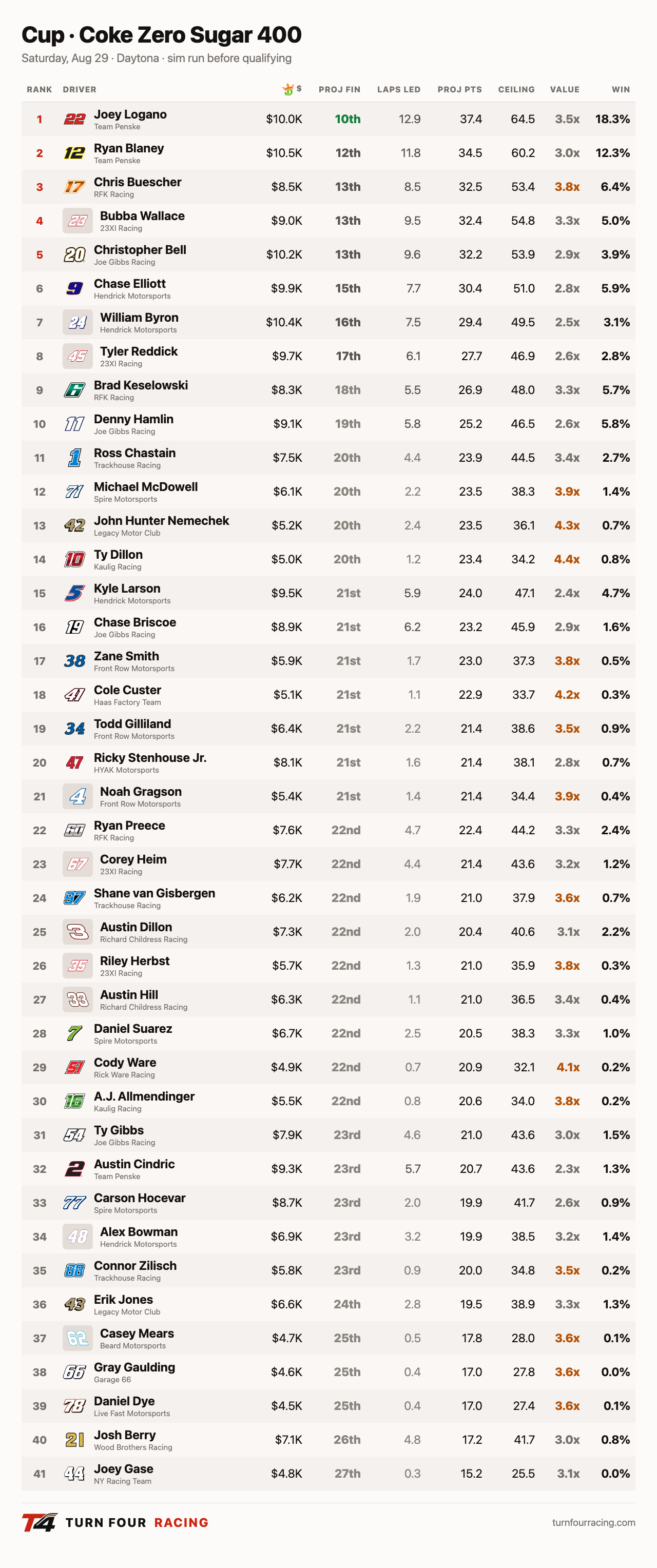
We run every race 10,000 times before the green flag, and a driver's number is his median finish across those runs. Joey Logano comes out of Saturday's 10,000 runs with the best number in the field at a median of 10th, and he finishes inside the top 10 in just over half of them. Nobody else projects better than 12th. At most tracks a top projection of 10th would be a soft headline.
The history agrees. Since 2022, at the three drafting tracks, meaning Daytona, Talladega and Atlanta, Logano has led 708 laps. That is the most of any driver entered on Saturday, and the next closest total is 508. If you play daily fantasy, Logano is also the $10,000 anchor of the DraftKings slate, salary being the price DraftKings puts on each driver against the fixed budget a lineup has to fit under.
Ryan Blaney is the one driver our sims and the field agree on. He won this race last year and won at New Hampshire last week. He is the most expensive driver on the DraftKings slate at $10,500, and he is projected for 37 percent ownership, meaning better than a third of all lineups entered are expected to have him. For once the chalk holds up: Blaney is second on our table at a median of 12th, and he finishes top 10 in 54 percent of our runs, the best rate in the field.
Chris Buescher is third on our table at a median of 13th, he finishes top 10 in 43 percent of our runs, and he costs $8,500. NBC Sports noted this week that Buescher has six top-10s in his last seven Daytona starts. Bubba Wallace is right behind him at a median of 13th.
The number that should stop a DFS player cold belongs to Chase Elliott. He is the second most popular play on the slate at 34 percent projected ownership, and our sims have him sixth on our table at a median of 15th. That is not a shot at Elliott. He has the best average finish at the drafting tracks of anybody racing Saturday, and the numbers on that are in the next section.
The drafting track specialists
Anyone can win Saturday, and the history is blunt about it. Of Daytona's last 43 Cup races, nine were won by a driver who led two laps or fewer. Seven were won by a driver who led exactly one lap all day.
That does not make drafting a coin flip. Skill at Daytona, Talladega and Atlanta is real and it shows up in our numbers. It also belongs to a slightly strange group of drivers. Everything below comes out of our own database: the current car, 2022 through now, those three tracks, drivers entered on Saturday only.
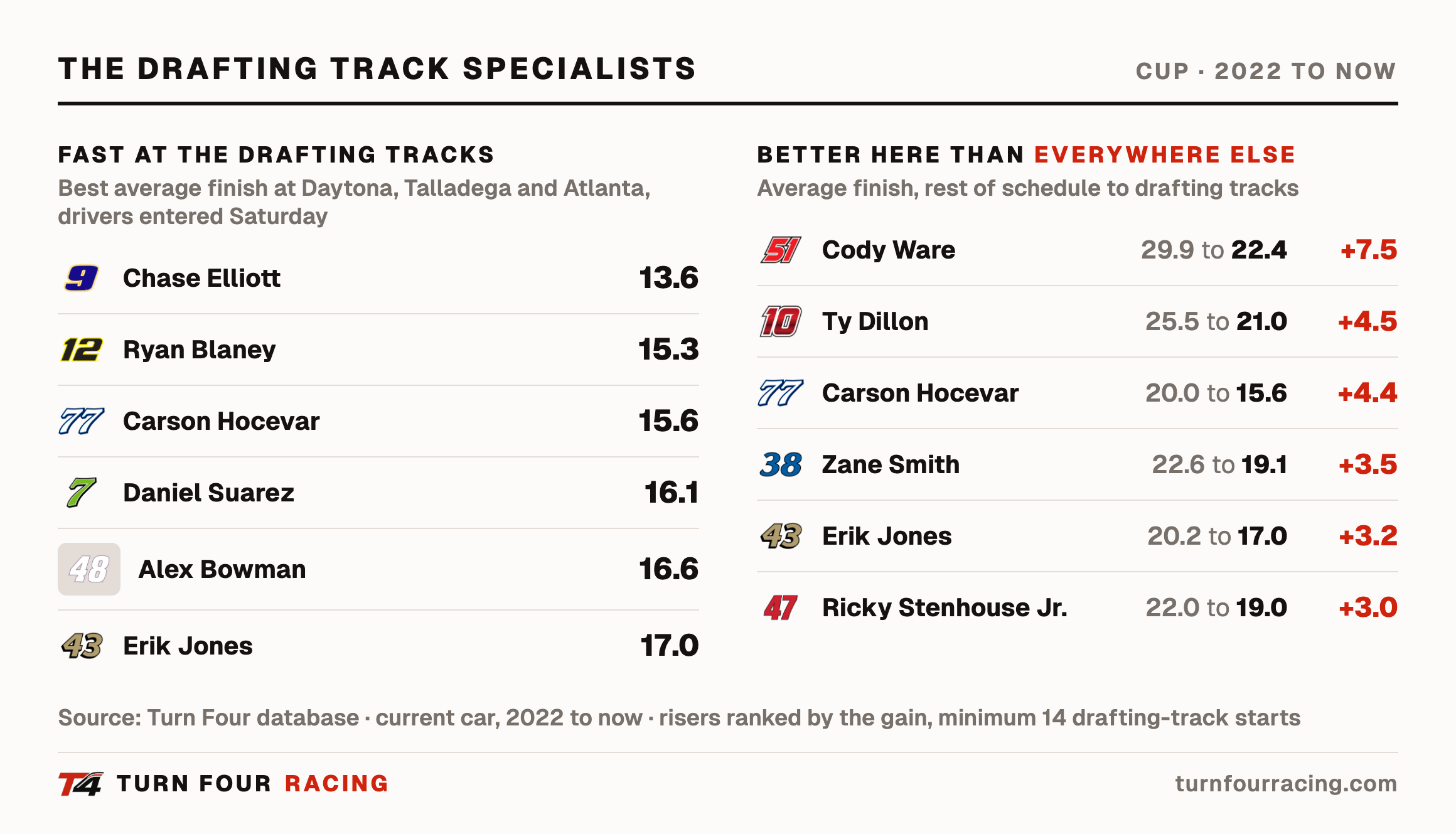
The first group is the drivers who are simply fast at drafting tracks. Chase Elliott has the best average finish in Saturday's field across Daytona, Talladega and Atlanta at 13.6. Ryan Blaney sits right behind him at 15.3, and Blaney has led 508 laps at those three tracks, second only to Logano. The popular play is popular for a reason.
Bubba Wallace is a different case, and the scope of his number matters. At Daytona alone, going back to 2005, no driver with 10 or more starts at the track has a better average finish than his 14.2. He has finished second at Daytona three times without ever winning it. It runs the other direction too: Kyle Larson has made 24 Daytona starts and has never finished in the top five.
The second group is the interesting one for anybody building lineups: drivers who spend most of the season running around 20th and turn into somebody else entirely at Daytona, Talladega and Atlanta. Same era, same database, their average finish at those three tracks against their average finish on the rest of the schedule.
Carson Hocevar averages 15.6 at the three drafting tracks against 20.0 everywhere else, a gain of 4.4 spots, and that 15.6 is the third-best drafting average finish in Saturday's field behind only Elliott and Blaney. Ty Dillon goes from 25.5 on the rest of the schedule to 21.0 at the drafting tracks, 4.5 spots better. Erik Jones improves from 20.2 to 17.0. Ricky Stenhouse Jr. improves from 22.0 to 19.0, and all four of his career Cup wins came at Daytona or Talladega, which is about as clear a statement as a career can make.
The biggest riser in the whole field also sits at the bottom of the DraftKings salary list. Cody Ware averages 29.9 on the rest of the schedule and 22.4 at Daytona, Talladega and Atlanta, a jump of 7.5 spots, and he costs $4,900. Ty Dillon is $5,000. On a normal weekend those two exist to free up money for somebody else, and at Daytona the bottom of the salary list is a strategy.
The projections page re-runs 10,000 sims every time driver news hits the wire or a session wraps up, for both Daytona races.
See the numbers as they moveFive drivers, three spots
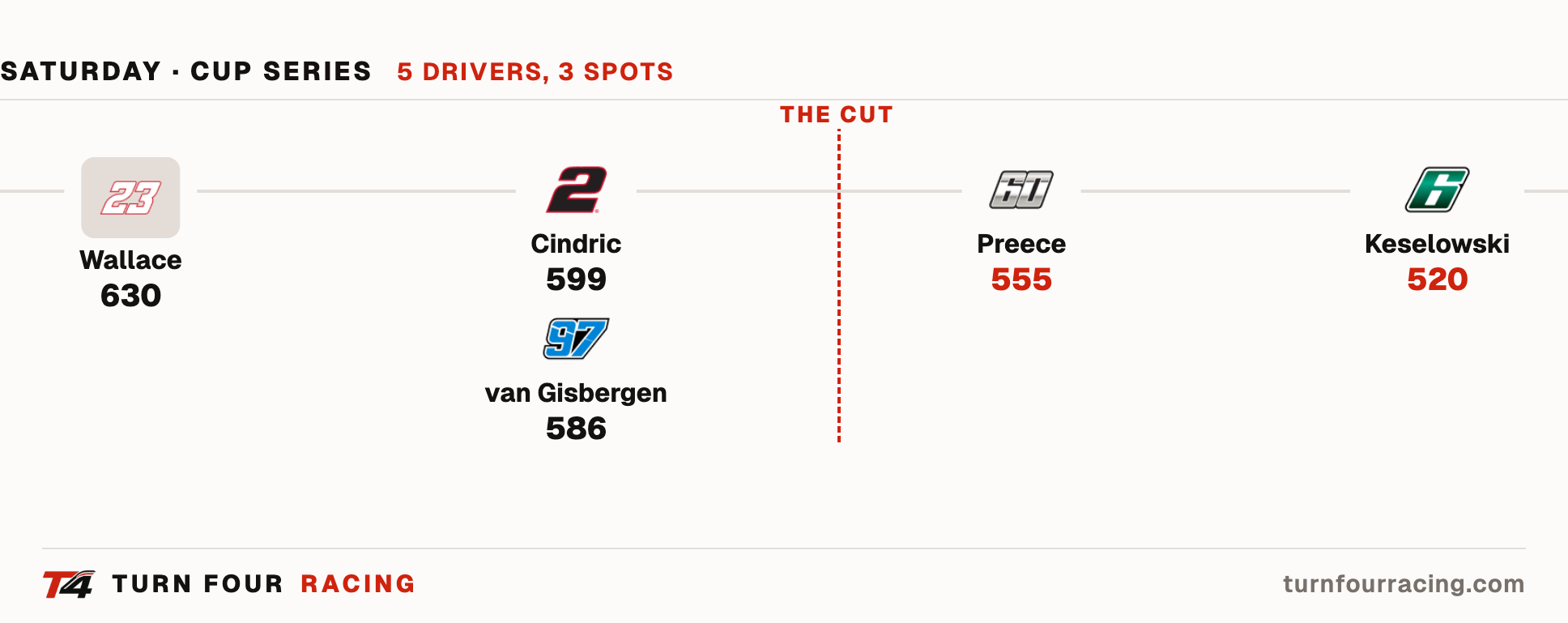
Thirteen drivers are already in. Five are racing for the last three places, and the arithmetic is lopsided. Bubba Wallace has 630 points and needs 2 more, which a finish of 35th or better covers. Short of a night that ends in the opening laps, Wallace is in. Austin Cindric has 599 and cannot be caught by Brad Keselowski under any set of results, because Keselowski's absolute ceiling is 596 points and Cindric's floor is 600. Shane van Gisbergen has 586 and holds the last spot, 31 points clear of Ryan Preece.
Below the line it gets ugly. Preece has 555 and has to outscore van Gisbergen by 32 points. The cleanest path is a win, and even a win only closes the gap if van Gisbergen finishes 14th or worse and takes no stage points along the way. Keselowski has 520 and needs a perfect night, all 76 points available, with van Gisbergen held to 9 points or fewer at the same time.
Our sims turned up something we did not see coming. Keselowski is in the deepest hole of the five and he carries our best projection of anyone currently outside the top 16, a median of 18th against Preece's 22nd. The driver who needs everything to break his way is the one our numbers like most on Saturday. That is Daytona. Wallace still projects best of the five overall at a median of 13th, but Wallace only needs 2 points, so all of the tension sits below him. The complete scenario map, with the points combinations worked out for all five, is in the stat pack at turnfourracing.com/pack.
Friday night belongs to Austin Hill
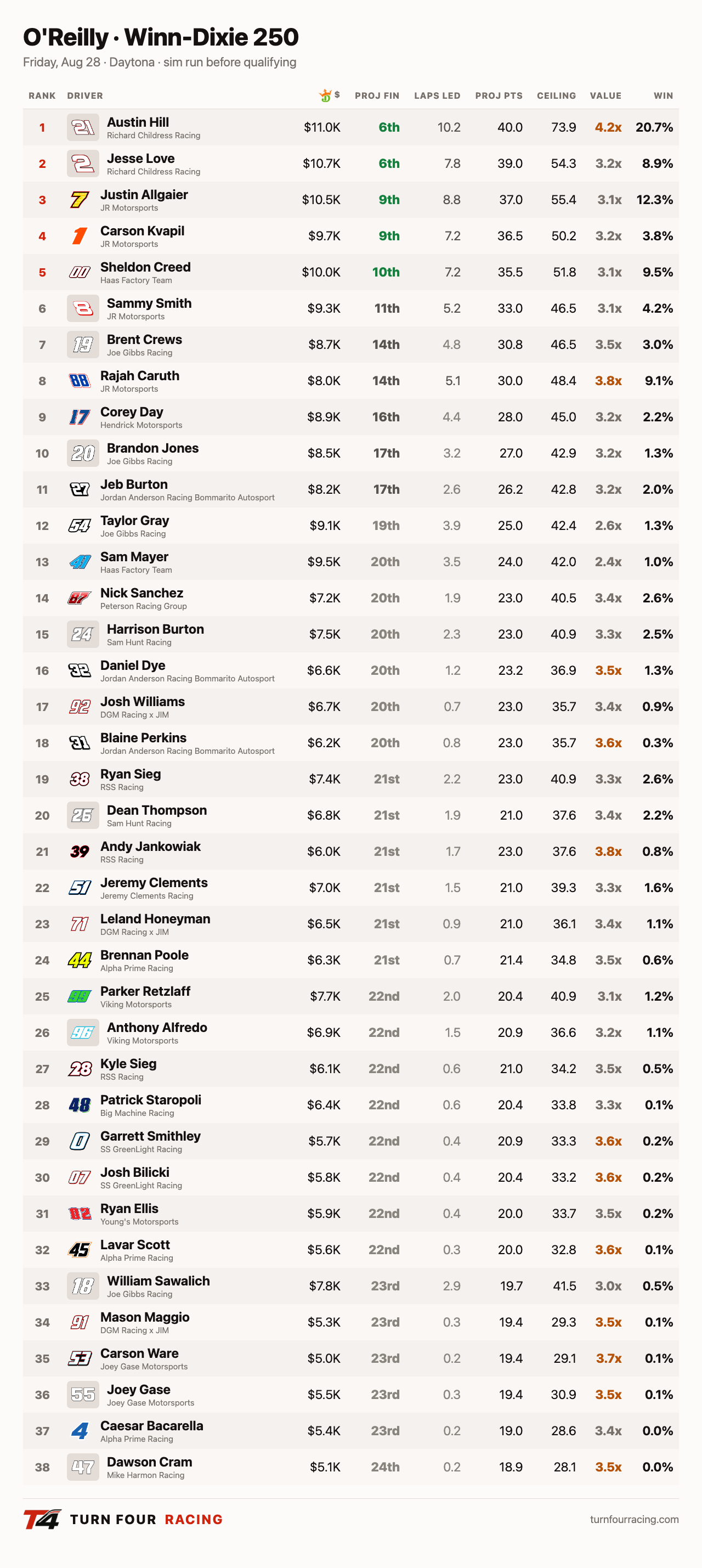
Richard Childress Racing announced on Monday that Austin Hill will run the No. 33 Cup car full time in 2027. He runs both races this weekend, and Friday night is the one where he is the most dangerous driver on the property. Hill has made six O'Reilly Series starts at Daytona and has won four of them, with 205 laps led. That is not a hot stretch. That is a driver who has worked out something about Daytona the rest of the field has not.
Our projections agree with the history. Hill is the Friday favorite in the Winn-Dixie 250 at a median of 6th, tied with Jesse Love for the best number in the field. Justin Allgaier has the steadiest read of anybody in the race, finishing top 10 in 62 percent of our runs. Rajah Caruth is the value we keep coming back to, at $8,000 with a median of 14th. The Winn-Dixie 250 goes green Friday night at 7:30 ET on the CW.
How our numbers have been running
Last week at New Hampshire our top pick was Ryan Blaney at a median of 5th, and he won the race. At Richmond we had Blaney at a median of 5th and he finished 13th. It was the same driver with the same number, and the two results looked nothing alike. A projection is a center of gravity, not a forecast of one finishing position, and that is the honest version of what these numbers are.
Our top pick has finished top 10 in 12 of 13 races since late May. We are putting that number in a Daytona preview on purpose, because Daytona is the race built to end a run like that, and this Daytona carries a rules package nobody has tested in traffic. If our top pick runs 27th on Saturday, that is not a system breaking down. It is the same track that has our best driver of the week missing the top 10 in half of his own runs.
With no practice, the only on-track information anyone gets before the green flag is Friday qualifying at 5 ET. If storms wash Friday out completely, owner points set the Cup field instead, and Casey Mears in the 62 is the car that goes home. The $5 projections page re-runs all 10,000 sims the moment qualifying wraps up, and again every time news hits the wire through Saturday night. That is what it exists for: a race where the inputs keep moving right up until the green flag.
The Coke Zero Sugar 400 goes green Saturday at 7:30 ET on NBC, with three Chase spots open and a rules package nobody has run in a pack. We do not know what that produces. Neither does anybody else, and for once that is the reason to watch instead of the disclaimer.
Full projections for both Daytona races, re-simmed through qualifying and driver news, right up to the green flag. The dynamic projections page is $5 a month; Pro opens the whole site.
See the full Daytona projections Plans, from $5 a monthNew here? We send one email a week: full projections for every race on the schedule. Free, every Thursday.
Get the Thursday email